
Pretty View for Transactions
Agora introduces Pretty View: human-readable summaries of proposal actions, so delegates can understand what they're voting on without decoding calldata.
Governance Shouldn't Require a Decoder Ring
Open any governance proposal and look at the executed actions. What you usually see is this:
- Target:
0x1f...1f984 - Calldata:
0x13af4035000000000000000000000000…
That's not a summary. That's a puzzle. Every contract call is encoded as a function selector followed by ABI-encoded arguments — a format designed for machines, not voters. For most delegates, the honest question is: what is this proposal actually doing?
Without a way to decode that data, delegates either skip the details, lean on the proposer's written summary, or quietly defer to whoever can read a contract ABI. None of those are good for governance.
Introducing Pretty View
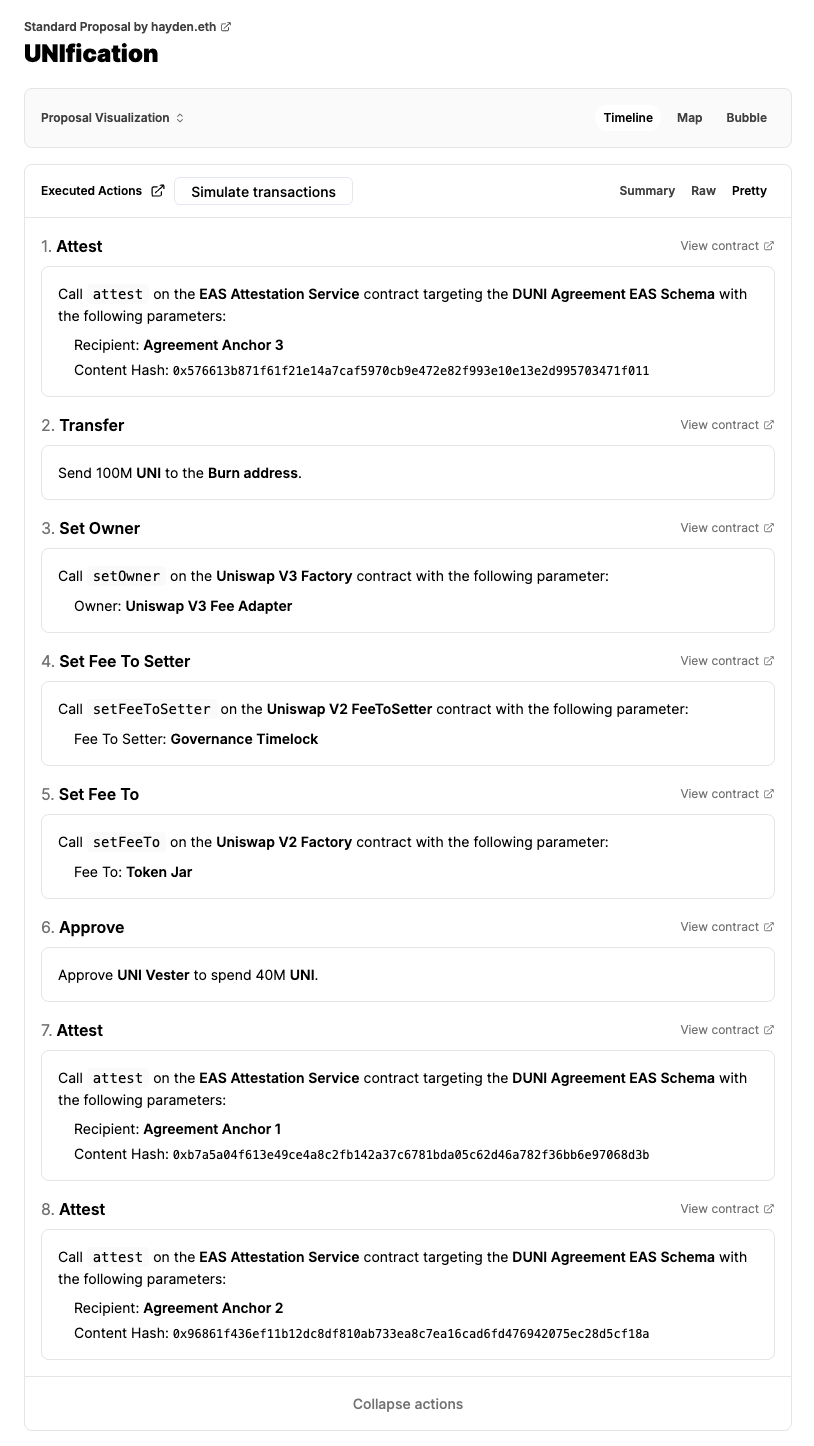
Proposal action pages on Agora now offer a new view — Pretty — alongside Decoded and Raw. It doesn't replace the existing Decoded and Raw views; it just gives you a third option that only shows up when the function selectors are all supported.
Switch to Pretty and each action is described in plain language: the contract being called, the function, and the key parameters — with human-readable names where we know them, and the raw address available on hover.
Instead of a hex dump, you see things like:
- Call
setOwneron the Uniswap V3 Factory with the following parameter: Owner: V3 Open Fee Adapter.
Delegates can scan the action list and understand what happens if the proposal passes — without opening Etherscan.
How It Works
Every contract call begins with a 4-byte function selector: a fingerprint of the function name and argument types (e.g. setOwner(address)). We maintain a curated set of supported selectors and, for each one, a template that knows how to decode the calldata into a readable sentence.
We also keep a registry of known contract addresses — factories, fee adapters, bridge contracts, L2 components — and display those as friendly labels rather than raw hex strings.
For cross-chain actions (L1 → L2 bridge calls, Wormhole, Polygon FxRoot, and others), we go one level deeper: we decode the outer call and the inner payload, so instead of "call sendMessage with bytes blob," you see the actual downstream action.
Two rules guide what we show:
- We only decode what we can decode correctly. If a proposal uses a selector we haven't mapped, we show Summary and Raw — no guessing.
- We source contract identities carefully. Address labels come from official deployment registries and verified sources, not inference.
The result is a best-effort, human-readable summary that's grounded in a fixed set of known selectors and addresses.
What's Covered Today
Current coverage spans the most common governance action types:
- Ownership and permissions —
setOwner,transferOwnership, and related admin functions - Fee configuration —
setFeeTo,setFeeToSetteracross V2 and V3 contracts - Token operations — transfers, approvals, vesting
- Cross-chain bridge calls — OP, Base, Arbitrum, Celo, Worldchain, Zora, Wormhole, Polygon
- ENS — text records, subnode records
- Basic EAS Attestations
We add new selectors and address labels based on usage.
Why It Matters
A governance system where voters can't read what they're voting on is a governance system that runs on trust instead of verification. Pretty View doesn't replace reading the full proposal or reviewing the underlying contracts — but it raises the bar. Delegates can quickly confirm "this proposal routes fee revenue to the Token Jar on six chains" or "this proposal adopts the SEAL Safe Harbor and updates an ENS record" without any specialized knowledge.
That's better for participation. And it's better for accountability — because when the actions are readable, so is the gap between what a proposal says it does and what it actually does onchain.
Pretty View is live on Agora-powered governance sites now. If you want coverage extended to more selectors, contracts, or chains for your deployment, talk to our team or send a PR to our open source gov client.